
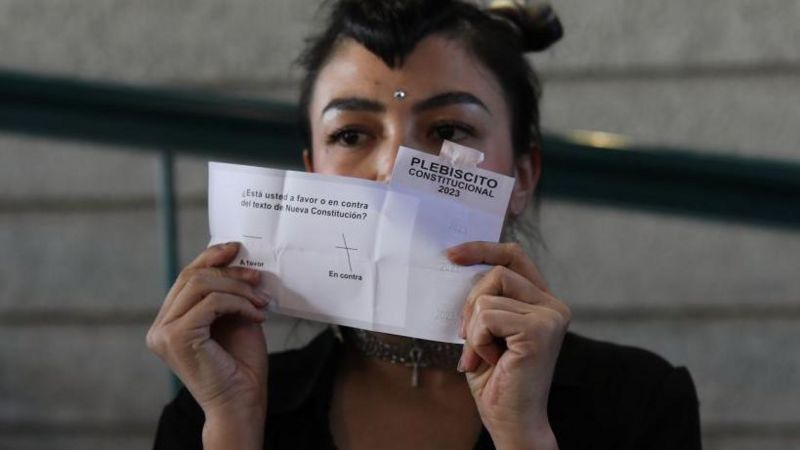
Chile has rejected, for the second time, a proposal to replace its current Constitution. With over 55% of support, the «against» option prevailed over the «in favor» option, which received 44% of support in the plebiscite held on Sunday, December 17. The South American country has spent the last four years trying to change its Magna Carta, since it was presented as an alternative to address the strong tensions of the social unrest that began in October 2019. The process has been closely followed by the world as a possible example of hope on how to address social demands through democratic mechanisms. However, the first attempt failed in September 2022, when 62% voted «against» a proposal that was labeled as «foundational» by some. One year and three months later, Chileans once again said no to a document that, for many, was more conservative than the current Constitution, inherited from the Augusto Pinochet regime (but reformed several times in democracy). The outcome of the election represents a defeat for the far-right led by former presidential candidate José Antonio Kast, who led this second proposal. And a bitter victory for predominantly left-wing sectors that were behind the «against» option but, for the second time, lost in their historical desire to change the current Constitution. How can we explain that Chile has stumbled twice in this process despite initially 80% of Chileans voting in favor of replacing their current Magna Carta? Here we explain.
1. Criticisms of the proposal’s content and the council
According to analysts consulted by BBC Mundo, one of the reasons that explains the victory of the «against» option is that the main contents of the proposal did not gather cross-party consensus. Critics of the document described it as «deeply neoliberal» and argued that it did not address the main demands that emerged forcefully in the massive protests in 2019, such as reforms to the healthcare, education, and pension systems. The change to the healthcare, education, and pension systems was perhaps the main demand made by the millions of Chileans who participated in the massive demonstrations in 2019. The proposal favored a mixed system in the provision of these services. In healthcare, it stated that the law should establish a universal healthcare plan, which could be offered by both state and private institutions. Something similar was proposed for pensions, where the State should guarantee access to basic and universal benefits that could be provided by «public or private institutions.» And in education, it emphasized the «freedom of teaching» and the preferential right of parents to their children’s education. According to its critics, the text did not ensure greater participation and involvement of the State in the provision of these services, but rather consolidated the model of the «subsidiary State» that currently exists and that, for many, is responsible for structural inequality in the country. Articles such as the one stating «the law protects the life of the unborn» or the one establishing «conscientious objection» were also questioned because, for some, they could endanger women’s rights, such as the law on abortion under three causes that has been in effect in Chile since 2017, or access to the morning-after pill. Even leaders from the right, such as Mayor Evelyn Matthei, who supported the «in favor» option, questioned the text, stating that it resembled more a «government program» of former presidential candidate José Antonio Kast. The second constitutional proposal was developed by a council led by the far-right Republican Party.
«There were norms that ideologically led the left to align against a proposal that was evidently biased towards the right,» explains Isabel Castillo, researcher at the Center for Conflict and Social Cohesion Studies (COES), to BBC Mundo. «In some sectors, there was a notion that the content was exaggerated,» adds Javier Sajuria, Chilean political scientist and professor at Queen Mary University in London. The work of the council was also poorly evaluated by the public. According to a survey by the Center for Public Studies (CEP), conducted in July, in the midst of the process, almost 40% of the people considered that it was done «badly or very badly,» while only 19% considered it was done «well or very well.» «We are facing a rather anomalous situation, where both the mechanism and the content of both attempts to change the Constitution failed,» Octavio Avendaño, PhD in political science and academic at the University of Chile, tells BBC Mundo.
2. «Constitutional fatigue» and other priorities
Chile is tired of the constitutional debate, and practically all opinion polls show it. Just one month before the election, a Cadem survey (one of the most reputable in the country) showed that one-third of voters (32%) were «little or not at all» interested in the process. There is talk of «constitutional fatigue» after these four years of efforts to change the Magna Carta. In the meantime, five elections have taken place (including plebiscites and elections to choose the councilors in charge of drafting the proposals), resulting in two failed attempts. «We have been prolonging this process for too long, wasting time on elections and with a political class that is inept and incapable of reaching an agreement,» Gabriela, a Chilean who voted against, tells BBC Mundo. According to Octavio Avendaño, one of the reasons for this lack of interest has to do with the failure of the first attempt, in which Chileans had placed their hopes. «The process suffered a huge discredit, and that had a detrimental effect,» he indicates. Today, experts say, constitutional change is no longer seen as a tool to overcome the crisis. «There is disappointment and little faith that the current elites can solve the problem,» says Javier Sajuria to BBC Mundo. Additionally, according to several researchers, the priorities of Chileans have changed. This is also shown by opinion polls, where security, crime, and drug trafficking are the top concerns of Chileans, followed by the economy. The South American country is going through one of the worst security crises in its recent history. The fear of becoming a victim of a crime reached its highest historical level two months ago, with over 30% of people declaring that fear, according to the Paz Ciudadana foundation. For Isabel Castillo, «there was a significant percentage of people who simply did not want a new constitutional process because it diverts political discussion from issues that are urgent to them.»
3. «Punishment» to the political class
Another reason that explains the failure of this process is that it failed to unite the different political sectors of the country. The same happened with the first attempt when center and right-wing groups insisted that they had been marginalized. This time, it was predominantly left-wing sectors that said they felt excluded. According to analysts, this led to a high percentage of voters marking the «against» option as a «punishment vote» towards the Chilean political class. «A scenario where everyone had agreed, defending the same proposal, would have been different. This was a punishment for the lack of cross-party consensus,» says Isabel Castillo. In line with this, on Sunday, after the results were announced, the president of the Socialist Party, Paulina Vodanovic, indicated that they must be able to reflect on the reasons why the «long-awaited unity» was not achieved. «The country missed the opportunity to have made a Constitution in democracy,» she added. It should also be considered that in Chile – and much of the world – approval of politicians has been decreasing considerably in recent years. Today, in fact, political parties and parliament are the institutions with the highest percentage regarding the «perception of corruption,» according to opinion polls. And in this constitutional process, unlike the previous one, political parties played a leading role. Thus, analysts agree that a high percentage of the «against» vote has to do with a rejection of the ruling class. «It is the consequence of an anti-political discourse that…
Con información de efectococuyo.com